
 Culture · By Anika Reddy
Rooted Radiance: How India is Rewriting Global Glamour
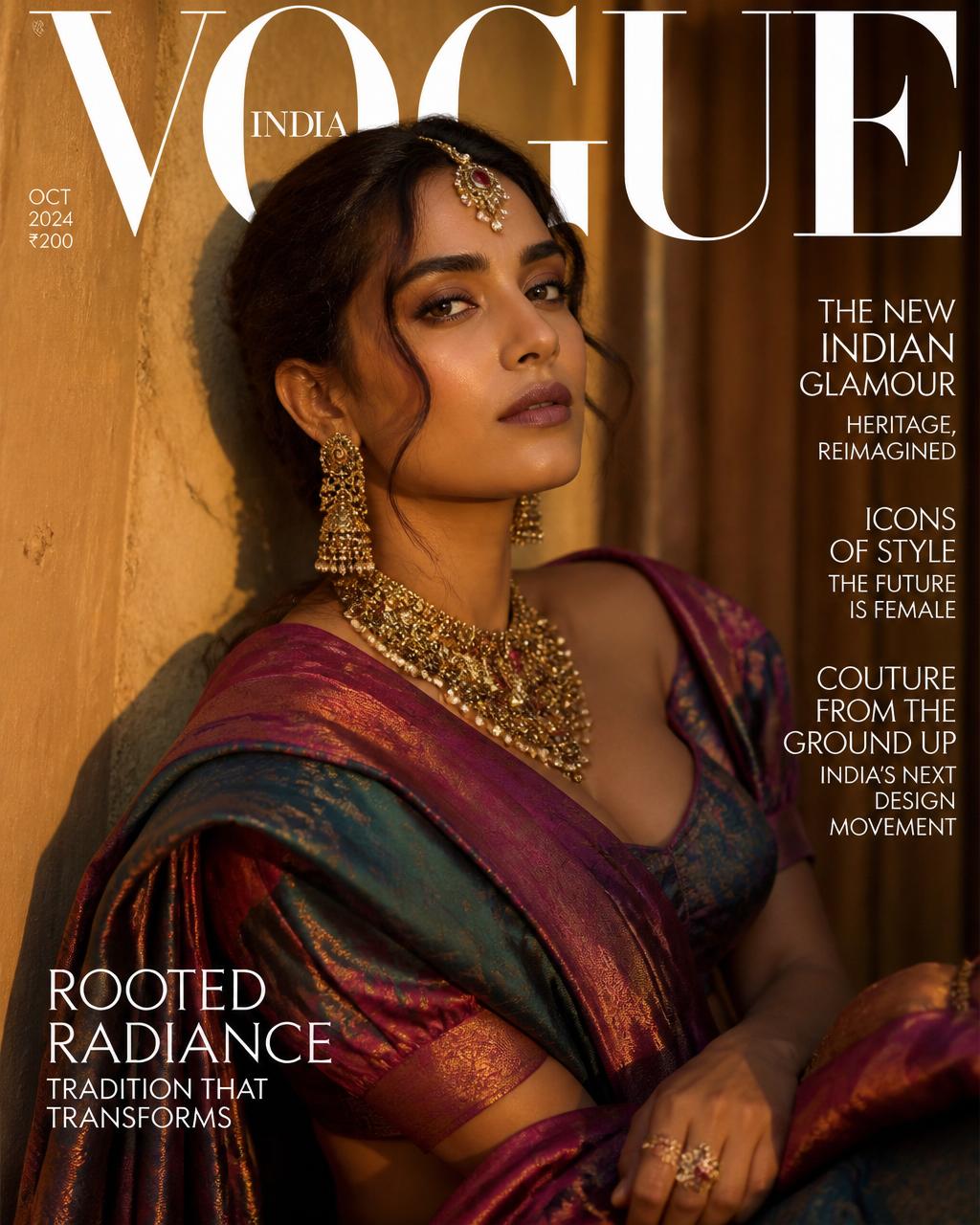
There is a particular kind of light in Jaipur in late October — low, gold, and unhurried — that makes everything it touches look like it was made by hand. Inside a courtyard atelier off the old city walls, a karigar is stitching the final row of zardozi onto a silk panel that will travel, three weeks from now, to a runway in Paris. He has been working on it since June. He is fifty-one years old. His father did the same work, in the same room, for forty years. This is the part of Indian fashion the international press still tends to miss. The runways are loud and photographable, the colors travel well on social, the celebrity wattage is undeniable. But the real story is quieter and older: a country in which couture-level handwork never stopped being a daily profession. While European houses spent the last decade reckoning with the slow disappearance of their petites mains, Indian ateliers in Lucknow, Kolkata, Varanasi, and Jaipur kept training apprentices the way they always had — by sitting them next to a master and handing them a needle. What is new is the design language wrapped around that craft. A generation of designers educated between Mumbai, London, and New York is treating heritage not as costume but as material — something to be cut, draped, deconstructed, and re-proposed for a global wardrobe. The sari is reappearing as a pre-draped, zipped silhouette engineered for a working week. Bandhani prints are being scaled up and used as the entire field of a tailored coat. Mirror work is migrating onto denim. None of it apologizes for itself. It helps that the country's domestic market is now large enough to support real risk. A decade ago a young Mumbai label needed an export buyer to survive its second season. Today, the wedding economy alone — estimated at well over fifty billion dollars annually — sustains entire ateliers, photographers, hair and makeup teams, and a small army of stylists whose work is as polished as anything coming out of Milan. International recognition has become a consequence of domestic confidence, not a precondition for it. The beauty story is following the same arc. Indian skincare brands are exporting Ayurvedic formulations that have, depending on how you count, somewhere between five hundred and two thousand years of testing behind them. Saffron, turmeric, kumkumadi, sandalwood — ingredients once filed under 'wellness' are being reformulated to the standards of contemporary cosmetic science and sold in matte glass bottles in Seoul, London, and Brooklyn. The marketing, increasingly, is unembarrassed about where it comes from. What ties all of this together is a refusal of the old global hierarchy in which Indian craft was raw material and European branding was the value-add. The designers we spoke with — eight of them, across four cities, over six weeks — were uniformly bored by the question of whether they wanted to be 'on the world stage.' They are already on it. What they want is for the world to stop describing them as emerging. It is a fair request. The work is here. The light is here. The hands have been here the whole time.